
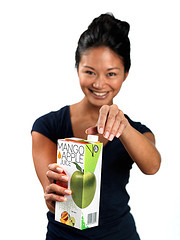
 My fiancee and I are having a green wedding. That means that we’re making conscious choices about the environmental impacts of every wedding-related decision we make, including what we provide to our guests. We decided not to provide soft drinks, but rather to provide a selection of healthier, organic juices. We went to the grocery store and found ourselves in a classic environmental dilemma, much like the ketchup bottle situation that Rick Smith found himself in when writing Slow Death by Rubber Duck. On one side, we found Santa Cruz Organic juices, a product of California and packaged in a glass bottle. On the other hand, we found Kiju Organic juices, a local Ontario product, packaged in a Tetra Pak container. Both products were the same price for roughly the same volume of juice, so there was no financial aspect to the decision. A glass bottle is more sustainable than a Tetra Pak, but a local product means it didn’t travel as far – if only there was a local product in a glass bottle! But alas, this is the classic environmental dilemma – more often than not, when trying to be environmentally responsible, you are faced not with an ideal choice, but with having to choose the lesser of two evils.
Tetra Pak – The Environmental Dilemma
3
 Planning my own wedding has led me to fully understand the value of hiring a wedding planner. I can’t say I expected it to be so much work. One of the reasons for all the work is that our wedding is also happening on the same day, and in nearly the same location, as a major city festival which attracts thousands of people and will totally be clogging up the area. It did not even occur to me to
  Firstly, many apologies to those who checked in this week and didn’t find a new post on Monday or Tuesday – it was partly due to the long weekend and partly due to the busyness of life. In fact, life seems so busy that I’m beginning to wonder if its negatively affecting me. I’m usually an exceedingly patient person – I’ve been told as much by many of my friends and family. But these days, it seems like my patience is waning. Is it a side-effect of life, or are we just becoming a less patient, more impersonal, rush-rush society? I’m not really sure but allow me to share a personal story to illustrate this…
 So badly needing a break from my research work, I watched a movie last night called
  . The movie was terrific but, combined with another of my favorite TV shows,
  , it left me going to bed thinking about a lot of philosophical issues. What if there are alternate realities to our own, all operating on a parallel timescale? Who could I be in another reality? Am I a millionaire, a celebrity, the founder of a charity…or maybe an unsuccessful average Joe? What would I have done differently in another reality in order to achieve more or less success? This left me thinking about the impacts of our decisions, both big and small, and how one simple decision can lead us on two completely different life paths.

 Go into your bathroom and look at the ingredients on every cosmetic or personal care product. Unless you are an avid purchaser of eco and/or health friendly products, I guarantee that almost all of them will list either Fragrance or Parfum as an ingredient. But what exactly is fragrance or parfum? The sad reality is that you might not want to know the answer.